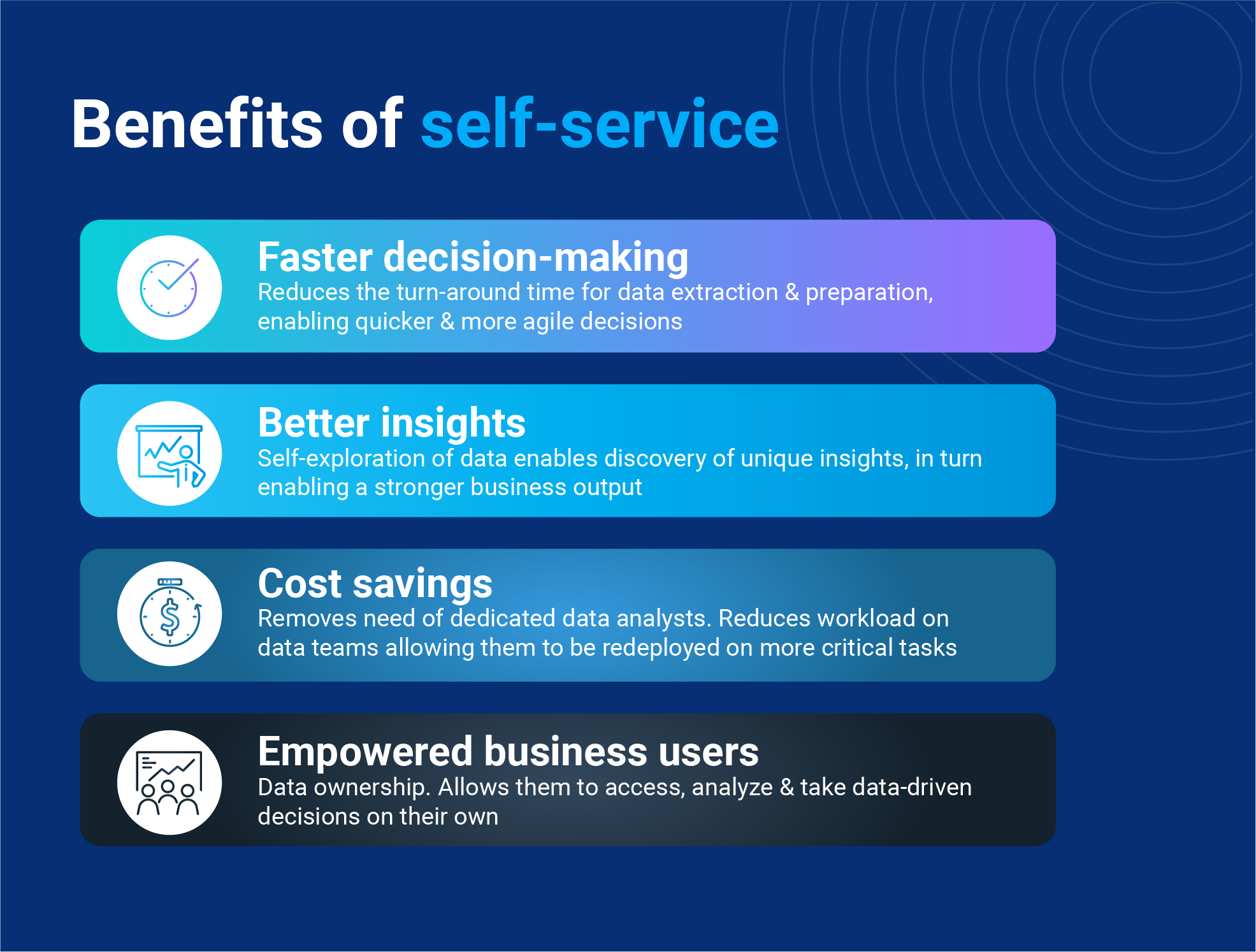
As a business user, have you waited days or even weeks for IT teams to extract and prepare business data for you? Do you only get canned reports with irrelevant metrics and lack of customizations? Inefficient data access and analysis can hinder organizations, burdening IT and data engineering teams with significant resources and leading to slower decision-making.
The solution? Self-service.
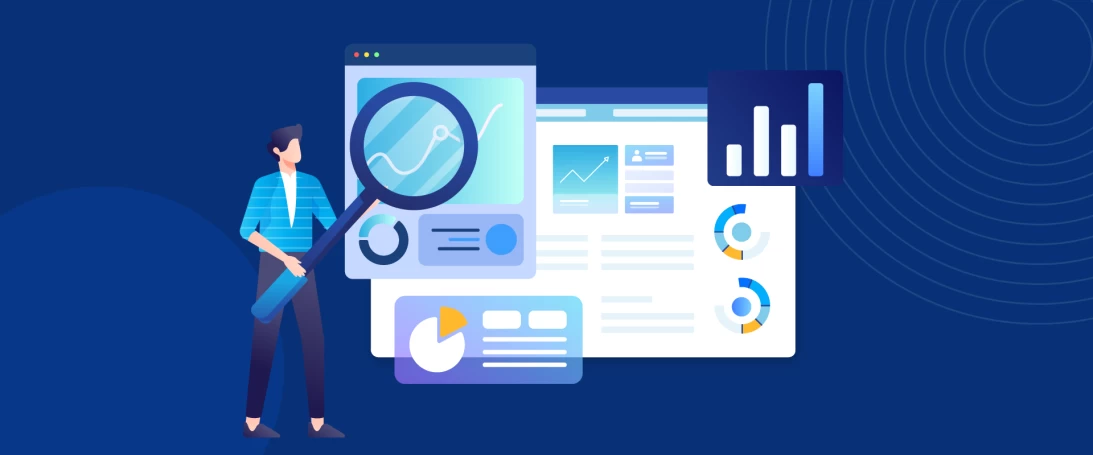
Self-service is an analytical solution which enables users to access and analyze data independently, with limited dependency on IT or data engineering teams. This is typically achieved using user-friendly analytics tools that provide users with the ability to query, visualize, and manipulate data to gain insights and make data-driven decisions. This approach empowers users to make business decisions without relying on a centralized team, freeing up data engineers to focus on more complex tasks. Self-serve analytics also helps to democratize data within organizations and improve agility in decision making.
Many people assume Self-service and BI to be the same but they are not. Self-service and BI tools serve different purposes and are designed for different user bases. Self-service is a Data solution which combines elements of business analytics, data engineering and BI and is focused on empowering non-technical users to quickly access and analyze data. While BI tools are designed for both technical and non-technical users and enable complex and ongoing data analysis and reporting. Importantly - The output for Self-service will depend on what the end-users are looking for and it can be in multiple forms. For instance, the output can be different Tableau dashboards as per business function or role related needs. Or it could be enabling end users to tweak queries as per personalized business needs. For users with high technical expertise & inclination to adopt data querying, it could even mean sandbox access to queries. BI output on the other hand is more structured and typically includes data visualization, reporting, dashboards, and predictive analytics.
Building blocks for a self-service solution
As mentioned above, the output of a self-service solution will depend on what the end-users are looking for. Hence the process must have end user buy-in, design inputs and ongoing training & support to ensure adoption.
.png)
While self-service data engineering can help organizations speed up decision-making and reduce the workload of IT and data engineering teams, it's important to be aware of its potential drawbacks. For instance, providing business users with too much freedom to access and manipulate data can lead to data inaccuracies and security risks. In addition, implementing and maintaining self-service data engineering can be complex, requiring investments in tools, technologies, and training. Therefore, organizations should ensure that users have appropriate data access levels and adhere to data security and governance standards. This may involve implementing data quality controls, data lineage, and audit trails to maintain data integrity. The following are some of the technical challenges that organizations may face while implementing self-service data engineering, along with some ways to overcome them:
Data quality: Self-service data engineering can lead to issues with data quality if users are not familiar with the data and its context. For example, if users are not aware of the source of the data or how it was collected, they may not be able to interpret it correctly. To address this challenge, organizations can implement data profiling and data quality monitoring tools that provide users with insights into the quality of the data. Data profiling tools can analyze data to identify patterns, inconsistencies, and outliers, while data quality monitoring tools can continuously monitor data for issues and alert users to potential problems.
Security: Self-service data engineering can lead to security risks if users are able to access data they should not have access to or if data is exposed to unauthorized users. To address this challenge, organizations can implement data access controls and data encryption to ensure that only authorized users can access sensitive data. Additionally, organizations can implement data masking and anonymization techniques to protect sensitive data from being exposed to unauthorized users.
Governance: Self-service data engineering can lead to issues with data governance if users are not aware of data policies and regulations. For example, users may not be aware of data privacy laws or data retention policies. To address this challenge, organizations can implement data governance policies and procedures that define data ownership, data quality standards, data security controls, and data access controls. Additionally, organizations can implement data lineage and data cataloging tools that provide users with insights into the data they are using and its context.
User Training: Self-service data engineering can be challenging for users who are not familiar with the tools and platforms. To address this challenge, organizations can provide users with training and education on the tools and platforms they will be using. This can involve creating user guides, tutorials, and online courses that help users understand how to use the tools and platforms effectively.
.png)
Finally - with advances in technology, there are several emerging trends in the self-service data engineering space that are worth noting.
Low-code/no-code data engineering: This trend is all about making data engineering more accessible to non-technical users by providing them with visual, drag-and-drop interfaces that allow them to create data pipelines and workflows without writing code. Low-code/no-code platforms often include pre-built connectors and templates that make it easier for users to integrate different data sources and automate data processing tasks.
Self-service data preparation: This trend is focused on providing users with tools to clean, transform, and combine data from different sources without relying on IT or data engineering teams. Self-service data preparation platforms often include automated data profiling and data quality checks, which help users identify and correct data issues more quickly.
Cloud-native data engineering: This trend is about leveraging cloud-based infrastructure and services to build and run data engineering pipelines and workflows. Cloud-native data engineering platforms often provide users with scalable and elastic compute and storage resources, as well as built-in tools for data processing, data warehousing, and data analytics.
AI-driven data engineering: This trend is about using artificial intelligence (AI) and machine learning (ML) to automate and optimize data engineering tasks. AI-driven data engineering platforms can automatically detect and correct data quality issues, recommend data transformations, and optimize data processing pipelines based on usage patterns and performance metrics.
Self-service data governance: This trend is focused on providing users with tools and processes to ensure that data is governed and managed effectively, even in a self-service environment. Self-service data governance platforms often include data cataloging, data lineage, and data access controls, which help users understand the context and lineage of the data they are using, as well as ensure that data is protected and compliant with regulatory requirements.
Overall, while self-service is a much needed element to empower business users and to speed up decision making, businesses can only ensure success by making the end-users an integral part of the solutioning process. With the right buy-in, the final solution will not only meet the business requirements, it will also use appropriate tools and processes which the users are comfortable with; provide user training & education for adoption; and ensure that data quality, security, and governance are maintained throughout the self-service solution.
Exploring self-service for your organization? Talk to us. Our team of experts can guide you on the roadmap. Reach out to us at contact@eucloid.com.